

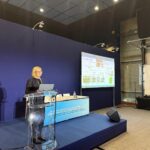
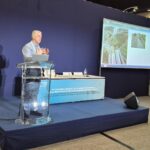
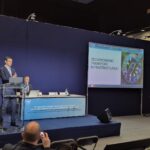
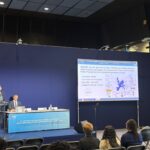
On 10 March 2026, the CIRCUIT project contributed to the 17th World Congress on Road Winter Service, Resilience and Decarbonisation, organised by PIARC – World Road Association in Chambéry, France.
The project coordinator, Thierry Goger (FEHRL), moderated the session “Sustainable, Resilient and Decarbonised Transport Infrastructure Management.” The session brought together leading experts including Irina Stipanovic (Infraplan Consulting), Carlos Martin-Portugues Montoliu (ACCIONA), and Kenneth Gavin (Delft University of Technology).
The discussion provided an opportunity to present the latest developments from CIRCUIT and to explore how the project contributes to integrating digitalisation, circular economy principles, innovative materials, and modern asset management frameworks into infrastructure decision-making.
Presentations highlighted how digital platforms and circular construction strategies can support more sustainable infrastructure management. Speakers also showcased innovative technologies — including energy-efficient lighting solutions, improved tunnel operation systems, and low-carbon pavement materials — that can significantly reduce energy consumption and carbon emissions across road infrastructure systems.
Overall, the session emphasised the importance of adopting a holistic life-cycle perspective in infrastructure management. Combining engineering innovation, improved data management and advanced decision-support tools is essential to address environmental challenges and climate-related risks.





Technical insights
From a more technical perspective, the discussion highlighted several key findings.
Digitalisation as an enabler of circular and sustainable infrastructure management
Digital technologies play a central role in enabling more sustainable infrastructure systems. Tools such as Building Information Modelling (BIM), digital twins and integrated data platforms improve the monitoring, management and integration of infrastructure data throughout the asset life cycle.
In addition, digital tools — including carbon footprint calculators, circularity analytics platforms and digital product passports — support material traceability and facilitate more effective reuse and recycling strategies.
Innovative solutions for reducing greenhouse-gas emissions
Several emerging technologies demonstrate strong potential to reduce greenhouse-gas emissions from road infrastructure.
These include hybrid renewable lighting systems combining photovoltaic panels and micro-wind turbines to offset energy consumption. Adaptive tunnel lighting systems, which adjust lighting levels according to traffic and environmental conditions, can significantly reduce energy demand, while intelligent tunnel ventilation systems further optimise energy performance.
At the material level, new asphalt technologies incorporating recycled materials and bio-based components can reduce the life-cycle carbon footprint of pavements while maintaining or even improving durability.
Sustainable and resilient geotechnical solutions
The discussion also emphasised the importance of sustainable and resilient geotechnical practices. The use of industrial by-products, such as fly ash and geopolymer materials, for soil stabilisation can enhance soil performance while reducing the use of virgin materials.
Moreover, the integration of sensor data and machine-learning techniques offers promising opportunities to monitor soil behaviour and better understand long-term deformation, subsidence and infrastructure stability.
Integrating sustainability into asset management
Finally, the session highlighted the need to integrate sustainability and resilience considerations directly into infrastructure asset management.
Decision-support tools such as Life-Cycle Cost Analysis (LCCA) and Life-Cycle Assessment (LCA) enable infrastructure agencies to balance cost, performance, risk and environmental impacts when planning maintenance and investment strategies. In this context, resilient infrastructure systems contribute to the long-term sustainability and reliability of transport networks.






Key recommendations
The session concluded with a set of recommendations for policymakers and international organisations.
Recommendations for decision-makers
Road authorities are encouraged to adopt life-cycle approaches across the planning, design, construction and maintenance of transport infrastructure. Investments in digital infrastructure management and monitoring systems should be prioritised to improve data availability and support evidence-based decision-making.
Authorities should also promote circular construction practices, including material reuse and the adoption of digital product passports to ensure traceability of infrastructure components.
The deployment of low-carbon technologies — particularly in lighting systems, tunnel operations and pavement materials — should be accelerated. At the same time, pilot and demonstration projects remain essential to test innovative solutions and support their wider implementation.
Finally, resilience considerations should be systematically integrated into infrastructure management, enabling transport systems to better respond to increasing climate-related risks.
Recommendations for international organisations
International organisations should continue to promote knowledge exchange and collaboration on digitalisation, circular infrastructure and resilient asset management.
Developing international guidelines and methodologies for integrating sustainability and resilience indicators into asset management systems would support infrastructure agencies worldwide. Further research collaboration should also be encouraged on topics such as low-carbon materials, energy-efficient infrastructure systems and data-driven monitoring technologies.
In this context, organisations such as PIARC – World Road Association can play a key role in facilitating cooperation between governments, research institutions and industry, helping to accelerate the deployment of innovative and sustainable infrastructure solutions.